
Reviewed · GYEONGJU UNESCO DAY TOURS
Full Day Busan and Gyeongju Guided Tour
Busan’s colorful hillside streets and Gyeongju’s ancient Silla monuments make an odd but appealing pair, and this full-day trip lets you see both without arranging separate transport. I like the way the route covers Gamcheon Culture Village and the Cheongsapo coast in Busan, then shifts to royal tombs, old villages, and a moonlit-looking bridge in Gyeongju.
I also like the practical setup: an air-conditioned vehicle, admission fees, pickup around Seomyeon and Busan Station, and a guide such as Bada or Jack to keep the day moving. The main tradeoff is time. You see many places, but the Gyeongju stops are short, and the beach portion may not include the private train ride some people hope for.
Key points to know before booking
- Two cities in one day: Cover major Busan sights and several central Gyeongju landmarks in about 9 to 10 hours.
- A strong first-time route: See Gamcheon Culture Village, Cheongsapo, Hwangnidan-gil, Daereungwon, Cheomseongdae, Gyochon Village, and Woljeonggyo Bridge.
- Useful transport included: Ride in an air-conditioned vehicle, with pickup and return arrangements around Seomyeon and Busan Station.
- Fast-paced Gyeongju sightseeing: Most stops last 30 to 60 minutes, with 90 minutes at Hwangnidan-gil.
- Meals are your responsibility: Lunch and dinner are not included, so plan your food budget and use free time wisely.
- Best for short stays: The $80.59 price makes most sense if you want broad coverage without spending a day planning trains, buses, and taxis.
One day from Busan’s alleys to Silla-era Gyeongju
This tour is built for the visitor who has limited time in Busan but still wants a taste of Gyeongju. You begin around Seomyeon Station, with pickup completed at Busan Station, then travel by air-conditioned vehicle to the first sightseeing stop.
The day lasts roughly 9 to 10 hours. That is long enough to reach both cities, but not long enough for a leisurely visit at every site. I would think of this as an efficient introduction rather than a slow cultural tour.
The group may include as many as 40 people. That keeps the price reasonable, but it also means meeting points and departure times matter. A guide such as Bada or Jack helps organize the day, and the feedback attached to the experience gives both names specific mention. Still, a larger group can make a short stop feel even shorter.
More Silla-era sites from Busan:
- Busan: Gyeongju Guided Day Trip to Three Kingdoms Capital
★ 4.8 · 1,925 reviews - From Busan: Gyeongju UNESCO World Heritage Guided Day Tour
★ 4.8 · 1,250 reviews - Gyeongju UNESCO World Heritage Guided Day Tour from Busan
★ 5.0 · 660 reviews
Gamcheon Culture Village and Busan’s hillside story
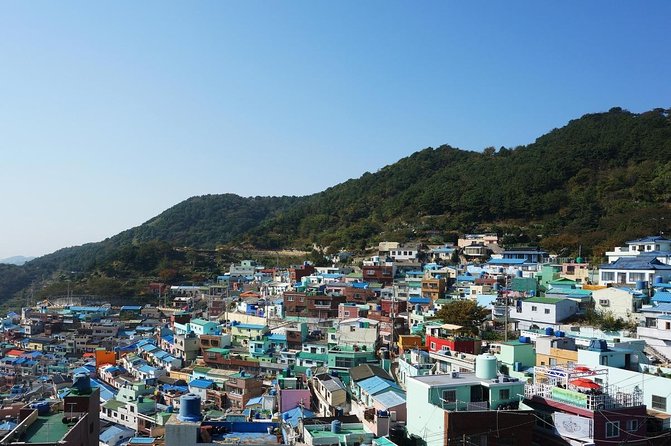
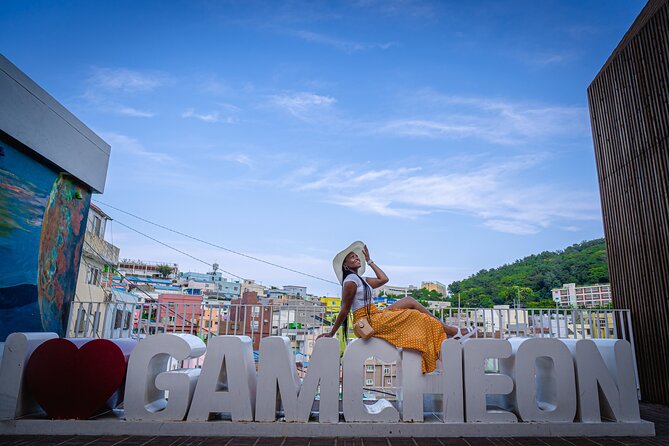
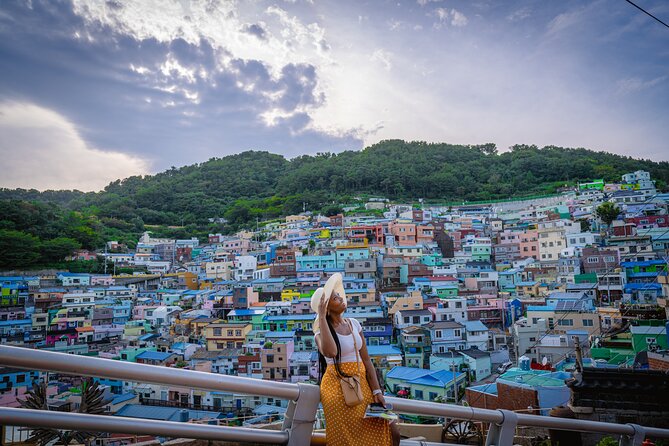
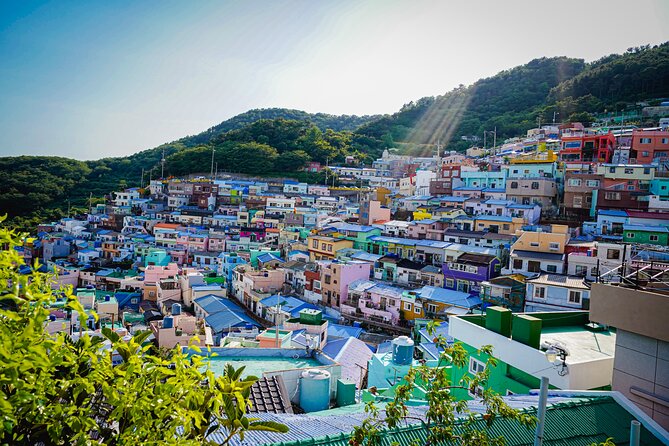
Gamcheon Culture Village is one of Busan’s most recognizable sights. The settlement began as a place where refugees lived during the Korean War. Today, its steep lanes and colorful buildings form the backdrop for one of the city’s most photographed visits.
You have about an hour here, with admission included. That is enough to walk through a compact section, take in the painted buildings, and get a sense of how an old residential area became a major cultural stop.
The nickname Santorini of Korea points to the stacked hillside houses and bright colors, but the real interest is the human story behind the neighborhood. I appreciate that this stop is not just a photo break. It connects modern Busan with the upheaval that shaped the city after the war.
The limitation is simple: one hour will not let you explore every lane. Wear comfortable shoes and expect some uphill or uneven walking. The tour requires a moderate level of physical fitness, and Gamcheon is one reason why.
Daereungwon gives Gyeongju its ancient scale
After Busan, the tour heads to Gyeongju, the former Silla capital and the main historical portion of the day. Daereungwon Tomb Complex is a broad park filled with large royal burial mounds from the Silla Dynasty.
You get about an hour here. The grassy tombs are the kind of sight that looks simple at first, then becomes more impressive as you understand what you are seeing. These are not isolated monuments behind glass. They are large burial mounds integrated into an open park, giving Gyeongju a distinct sense of age and scale.
This stop works well early in the Gyeongju section because it gives you context for the places that follow. You begin to see the city not as a collection of unrelated attractions, but as a former royal center with important remains spread through present-day streets.
The quick schedule means you should listen carefully to the guide and make your photographs efficiently. If you prefer long visits inside museums or archaeological sites, this route may feel rushed.
Hwangnidan-gil mixes old buildings with modern street life
Hwangnidan-gil receives the longest stop in Gyeongju, about 90 minutes. The street is known for preserved buildings dating from the 1960s, along with the old-fashioned atmosphere created by low structures and traditional design details.
This is where the tour shifts from formal monuments to everyday street scenes. You can walk, browse, and use the time to find something to eat if the schedule and local options allow. Since lunch is not included, Hwangnidan-gil is the most natural part of the day to handle food, though the tour information does not promise a dedicated meal break.
I like having this longer pause in the middle of a packed itinerary. After the tomb complex, a street visit gives you a change of pace and lets you experience Gyeongju as a living town, not only as an open-air history site.
Keep an eye on the meeting time. Ninety minutes sounds generous, but it passes quickly if you stop for food and photos. The route still has several more sights ahead.
A few more things to do in Busan worth a look
- Small Group Full Day Busan Tour (Max 6 Pax)
★ 5.0 · 1,464 reviews - Authentic Busan Full-Day City Highlights Tour
★ 5.0 · 272 reviews - Full-Day Tour Unmissable things to do in Busan
★ 5.0 · 195 reviews - Full Day Busan Tour Including Haedong Yonggungsa Temple
★ 4.5 · 71 reviews
Cheomseongdae is a short stop with major importance

Cheomseongdae Observatory receives about 30 minutes. Built during the Silla Dynasty in the seventh century, it is one of the oldest surviving astronomical observatories in East Asia.
The structure is a cylindrical stone tower, and its shape is easy to recognize once you reach it. The stop is brief because the monument is viewed from outside, but the age and purpose give it unusual weight. It shows that Silla was not only a kingdom of tombs and palaces, but also a place where astronomy mattered to government and daily life.
Thirty minutes is enough for photos and an explanation from the guide. I would not expect a long site visit or a museum experience here. Think of it as a focused historical pause between larger stops.
Woljeonggyo Bridge adds a graceful finish to the old city
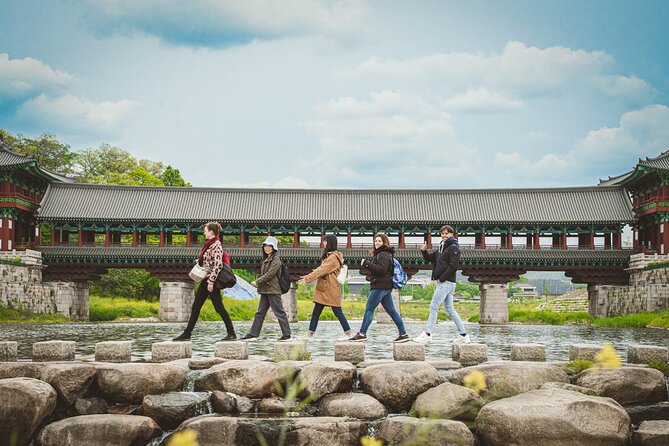
Woljeonggyo Bridge is another 30-minute stop. It is known as an important historical bridge and one of the country’s oldest surviving wooden bridges.
The bridge gives you a different view of Gyeongju. Daereungwon is about burial mounds, and Cheomseongdae is about science and royal power. Woljeonggyo brings in architecture, water, and movement through the old city.
Half an hour is suitable for crossing or viewing the bridge and taking photographs, but it is not enough for a long walk along the surrounding area. The attraction is especially appealing if you enjoy traditional Korean design and want a visual contrast with the round tombs and stone observatory.
Gyochon Village shows traditional Korean architecture
Gyeongju Gyochon Traditional Village receives about 40 minutes. Its preserved hanok houses and winding streets give you a look at traditional Korean architecture in a quieter setting than Hwangnidan-gil.
This stop helps round out the Gyeongju portion. You have already seen royal tombs, an observatory, and a historic bridge. Here, you get a more domestic view of the old city through houses, lanes, and traditional forms.
Forty minutes should let you walk through part of the village and take photographs. It is not a full village stay, so I would avoid expecting time for a long, unhurried exploration. The value comes from seeing several types of historic places in one day.
Cheongsapo brings you back to the Busan coast
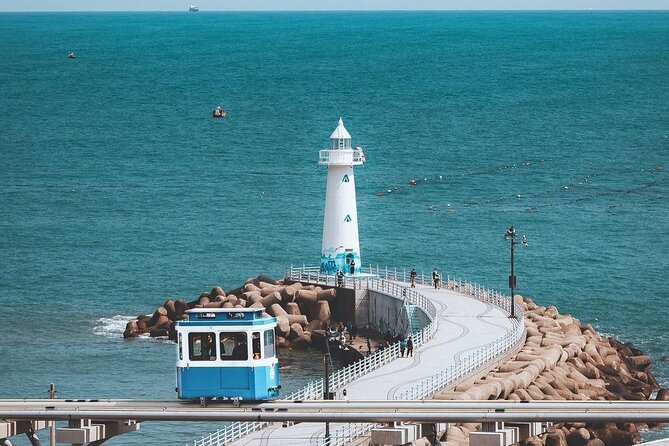
The final major sightseeing stop is Cheongsapo Daritdol Skywalk, with about 90 minutes allocated. Cheongsapo is part of Busan’s coastal Haeundae Blue Line area, and the route describes a scenic beach train experience connected with this section.
This is the tour’s main change of mood after a full day among historic sites. You return to the coast for sea views and a modern Busan attraction. The skywalk is the focus listed for the stop, while the wider Cheongsapo area is linked to the beach train.
Pay close attention to what is included. The tour includes admission fees, but a private beach train ride is not guaranteed by the information provided. One person specifically wished there had been more time for the beach train and less time in Gyeongju. If that ride is your top priority, confirm the exact arrangement before booking.
Ninety minutes gives you more breathing room than the 30-minute Gyeongju stops, but the day is already long. You may appreciate the coastal air and open views, while also feeling ready for the ride back.
Returning through Seomyeon and Busan Station

The return portion takes about 40 minutes to Cheongsapo-ro and then continues toward the drop-off points. The tour first drops off around Seomyeon Station, with completion at Busan Station. Busan Chinatown is also listed in the final transfer sequence, with about 20 minutes connected to the end of the route.
The exact order of drop-offs matters if you have evening plans. Do not schedule a tight dinner reservation or train connection immediately after the advertised finish. Traffic and the needs of a group of up to 40 people can affect the final timing.
The pickup setup is useful because both Seomyeon and Busan Station are central reference points. The experience is near public transportation, which makes it easier to connect with the rest of your Busan plans.
What the $80.59 price really covers
At $80.59 per person, the price is reasonable if you value transport and a packed route. You are paying for an air-conditioned vehicle, admission fees, and a full day that links two destinations. Organizing the same day independently would require sorting out intercity transport, local transfers, and the order of several spread-out sights.
The value is less clear if you want long visits at each location. The tour covers a lot, but its schedule is built around short stops. You are buying reach and convenience rather than maximum time at one attraction.
Meals are not included. Set aside money for lunch and dinner, and use the 90 minutes at Hwangnidan-gil carefully if you need food during the day. The price does not include a private beach train ride unless the operator confirms that arrangement for your date.
The average booking point is 71 days ahead, which suggests planning early may be sensible for a specific travel date. Confirmation is provided at booking, and the ticket is mobile, so you do not need to manage a printed voucher.
Who will enjoy this fast-paced route
I would recommend this tour to you if:
- You have only a short stay in Busan.
- You want to see both Busan and Gyeongju without planning the transport yourself.
- You prefer a guide and a fixed route.
- You are comfortable walking for much of the day.
- You would rather collect a broad first impression than spend several hours at one site.
- You want the main Gyeongju highlights in a single outing.
I would hesitate if you want a slow day, a private experience, or a deep visit to one historical site. The maximum group size is 40, and the timetable leaves little room to linger.
The tour also suits you better if Gamcheon Culture Village and Cheongsapo are priorities. If Gyeongju is your main reason for booking, consider how you feel about the short 30 to 40-minute stops at Cheomseongdae, Woljeonggyo Bridge, and Gyochon Village.
Booking, weather, and cancellation details
You can cancel for a full refund if you do so at least 24 hours before the start time. Changes or cancellations made within 24 hours are not accepted for a refund.
The experience depends on good weather. If poor weather causes cancellation, you will be offered another date or a full refund. The tour also requires a minimum number of people. If that minimum is not reached, you will be offered another date or experience, or a full refund.
Confirmation arrives at booking, and the mobile ticket is convenient for a day when you are moving between cities. The tour is near public transportation, but you should still allow time to reach the stated pickup area.
Should you book this Busan and Gyeongju tour?
Book it if your Busan visit is short and you want an efficient day with a guide, included transport, and a solid list of major sights. The route gives you colorful Busan, coastal Cheongsapo, and several of Gyeongju’s most recognizable Silla-era places for $80.59.
Skip it if you want a relaxed historical tour or if riding the private beach train is essential. The strongest reason to choose this experience is its coverage. You see a lot in one day, guided by people such as Bada or Jack, but you must accept short visits and a full schedule.
FAQ
How long does the Busan and Gyeongju tour last?
The tour lasts approximately 9 to 10 hours.
How much does the tour cost?
The listed price is $80.59 per person.
Where does the tour begin?
The tour starts around Seomyeon Station, with pickup completed at Busan Station.
Where does the tour end?
The tour returns toward Seomyeon Station and Busan Station. The final sequence also lists Busan Chinatown.
Is transportation included?
Yes. The tour includes an air-conditioned vehicle.
Are admission fees included?
Yes. All fees and taxes are included, along with admission for the listed included attractions.
Are lunch and dinner included?
No. Lunch and dinner are not included.
What places are visited in Gyeongju?
The Gyeongju stops include Daereungwon Tomb Complex, Hwangnidan-gil, Cheomseongdae Observatory, Woljeonggyo Bridge, and Gyochon Traditional Village.
Is the private beach train included?
The supplied tour details do not confirm a private beach train ride. The Cheongsapo stop includes the Daritdol Skywalk and relates to the Haeundae Blue Line Park area.
How far in advance can I cancel for a full refund?
You must cancel at least 24 hours before the experience start time for a full refund.
What happens if bad weather cancels the tour?
You will be offered a different date or a full refund.
How large can the group be?
The tour can have a maximum of 40 people.
Does the tour require physical fitness?
Yes. Participants should have a moderate level of physical fitness.
Just added in Busan
- Visit Busan night market and enjoy the night view of Busan harbor★ 5.0 · 6 reviews
- Real Busan Walking Experience★ 5.0 · 27 reviews
- Full Day Private car tour to UNESCO Gyeongju&Yangdong village★ 5.0 · 5 reviews
- Suncheon and Yeosu Daily Private Tour with Pickup Service★ 5.0 · 3 reviews
- 7 Highlights Gyeongju City One Day Small Group Tour from Busan★ 5.0 · 24 reviews
- Busan Seafood Tour : Oyster village Tour with Oyster cuisines★ 5.0 · 3 reviews
- 1 Day Private Busan Guided Tour★ 4.5 · 3 reviews
- Suncheon one day tour from Seoul, Busan or Suncheon★ 5.0 · 3 reviews
Gyeongju UNESCO Day Tours, compared.
Gyeongju Guided Day Trip to Three Kingdoms Capital
Read our review →
Gyeongju UNESCO World Heritage Guided Day Tour
Read our review →
Old Korea Thousand History Tour of Gyeongju from Busan
Read our review →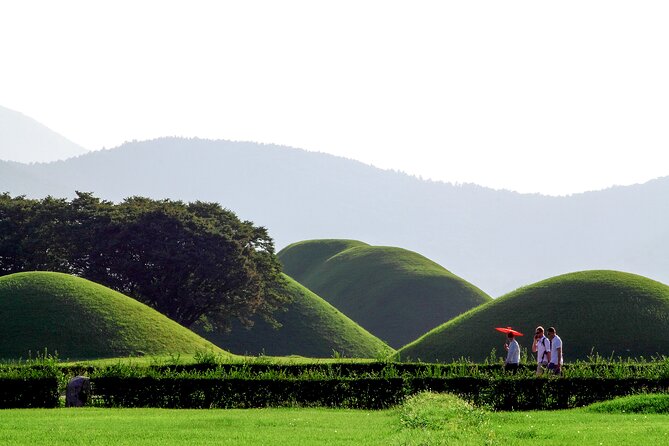
Gyeongju UNESCO sites Private tour with licensed tour guide
Read our review →
Private Gyeongju Tour – Explore Gyeongju UNESCO Sites
Read our review →
Gyeongju UNESCO Legacy Tour with National Museum
Read our review →
UNESCO Heritage Tour Including Bulguksa Temple
Read our review →
Gyeongju UNESCO World Heritage Sites and History Full-Day Tour with Lunch
Read our review →Browse the lists this tour appears in